

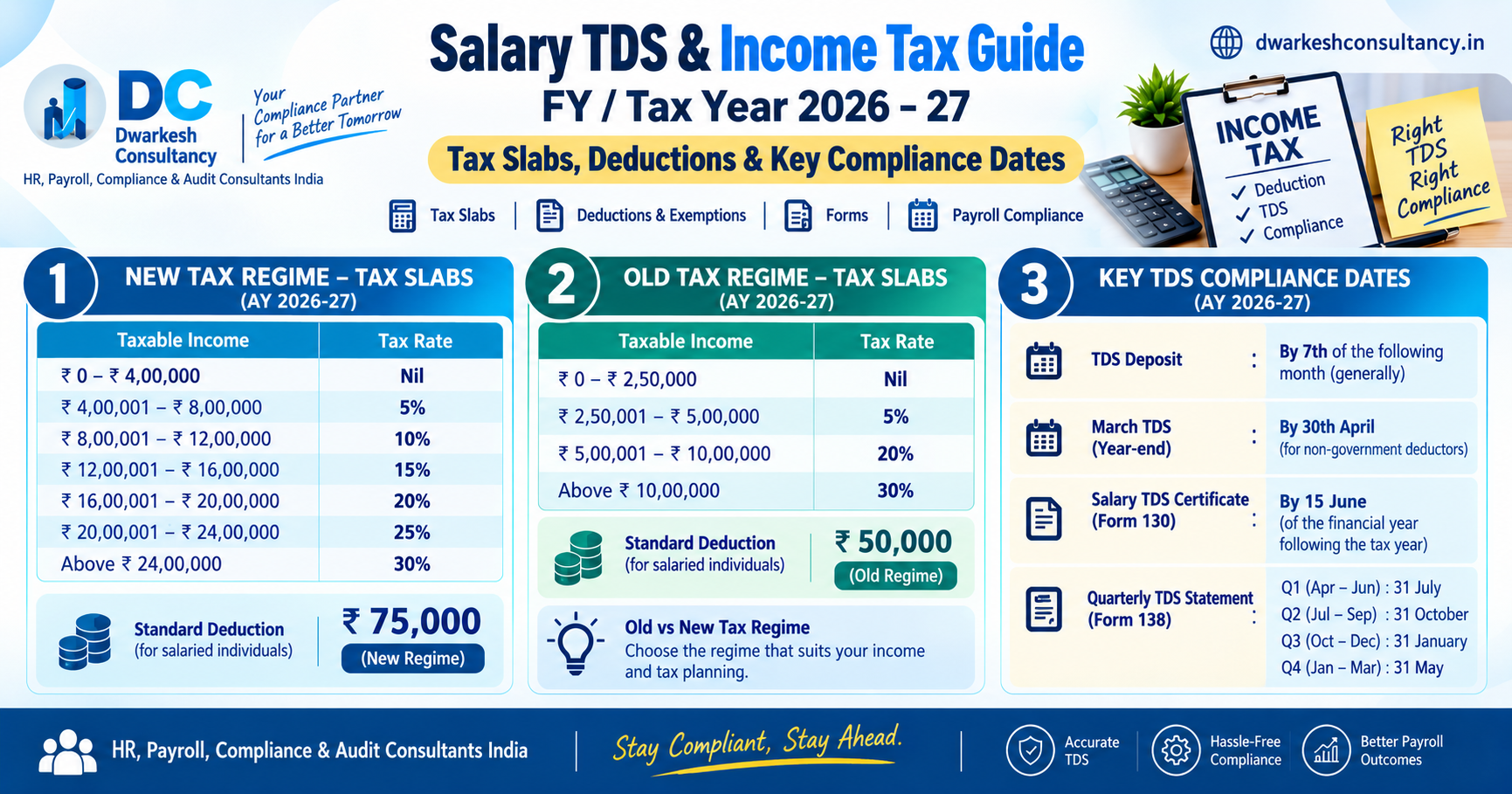
Salary TDS & Income Tax Compliance Guide – FY / Tax Year 2026–27 From 1 April 2026, the Income-tax Act, 2025 applies to income earned during Tax Year 2026–27. Under the new Act, the expression “Tax Year” replaces the earlier concepts of previous year and assessment year for current income earned from FY 2026–27 onward. Income Tax India New Tax Regime – Tax Slabs for Tax Year 2026–27 The applicable tax rates under the default/new tax regime are: Total Income Tax Rate Up to ₹4,00,000 Nil ₹4,00,001 – ₹8,00,000 5% ₹8,00,001 – ₹12,00,000 10% ₹12,00,001 – ₹16,00,000 15% ₹16,00,001 – ₹20,00,000 20% ₹20,00,001 – ₹24,00,000 25% Above ₹24,00,000 30%
These rates have been prescribed for FY/Tax Year 2026–27. India Budget Under the new regime, a rebate of up to ₹60,000 is available to eligible resident individuals where total income does not exceed ₹12 lakh. Income Tax India For salaried taxpayers, the ₹75,000 standard deduction can effectively make salary income up to approximately ₹12.75 lakh tax-free in ordinary cases, subject to the applicable provisions and nature of income. Old Tax Regime Taxpayers who validly opt for the old regime may continue to use the applicable traditional slab structure, along with eligible exemptions and deductions such as HRA, eligible investments, insurance-related deductions, housing-loan benefits and other permitted deductions. For individuals below 60 years, the conventional slab structure is: - Up to ₹2,50,000 – Nil - ₹2,50,001 to ₹5,00,000 – 5% - ₹5,00,001 to ₹10,00,000 – 20% - Above ₹10,00,000 – 30% The rebate for eligible resident individuals under the old-regime framework is up to ₹12,500 where taxable income does not exceed ₹5 lakh. Income Tax India Employee Documentation Employees should provide the employer with applicable declarations and supporting information for correct TDS computation. Relevant records may include: Form 12BB: used by employees to provide details of eligible claims such as HRA, LTC, housing-loan interest and qualifying investments or deductions. Form 16: the annual salary TDS certificate issued by the employer, containing salary, deductions, exemptions and TDS details. Form 16A: generally applicable to TDS on income other than salary. Income Tax India Employer TDS Compliance Employers should: - Obtain the employee's tax-regime declaration. - Estimate the employee's annual taxable salary. - Consider eligible exemptions and deductions. - Calculate annual tax liability. - Deduct TDS appropriately from salary payments. - Deposit deducted TDS within the prescribed timeline. - File quarterly salary-TDS statements. - Reconcile payroll TDS records with tax reporting. - Issue the applicable salary TDS certificate to employees. - Ensure employees can verify corresponding tax credits in their tax records. TDS Deposit Due Dates Generally, TDS must be deposited with the Central Government by the 7th day of the following month. For TDS deducted in March by non-government deductors, the applicable deadline is generally 30 April. Income Tax India Quarterly Salary TDS Statement Under the Income-tax Act, 2025, Form 138, which replaces the earlier Form 24Q terminology, is used for quarterly reporting of salary-related TDS. The prescribed due dates are: Quarter Period Due Date Q1 April – June 31 July Q2 July – September 31 October Q3 October – December 31 January Q4 January – March 31 May